
Hard Platooning is a novel vehicle platooning technology in which multiple vehicles are physically linked using a product called the Hard Connect. Unlike traditional Leader-Follower (LF) systems, where robotic vehicles follow a human-driven or remotely operated lead vehicle using wireless communication, Hard Platooning uses a physical tether. This setup allows one person to control multiple vehicles at the same time, reducing the workload for soldiers and improving coordination. The physical connection 1) Improves cyber security by using passive sensors and secure wired connections for data transfer, 2) Reduces cost, using simple geometry sensors and lightweight computations in place of expensive LiDAR, camera, and compute systems, and 3) Adds a layer of safety to physically restrain the vehicles in the event of mechanical failure.
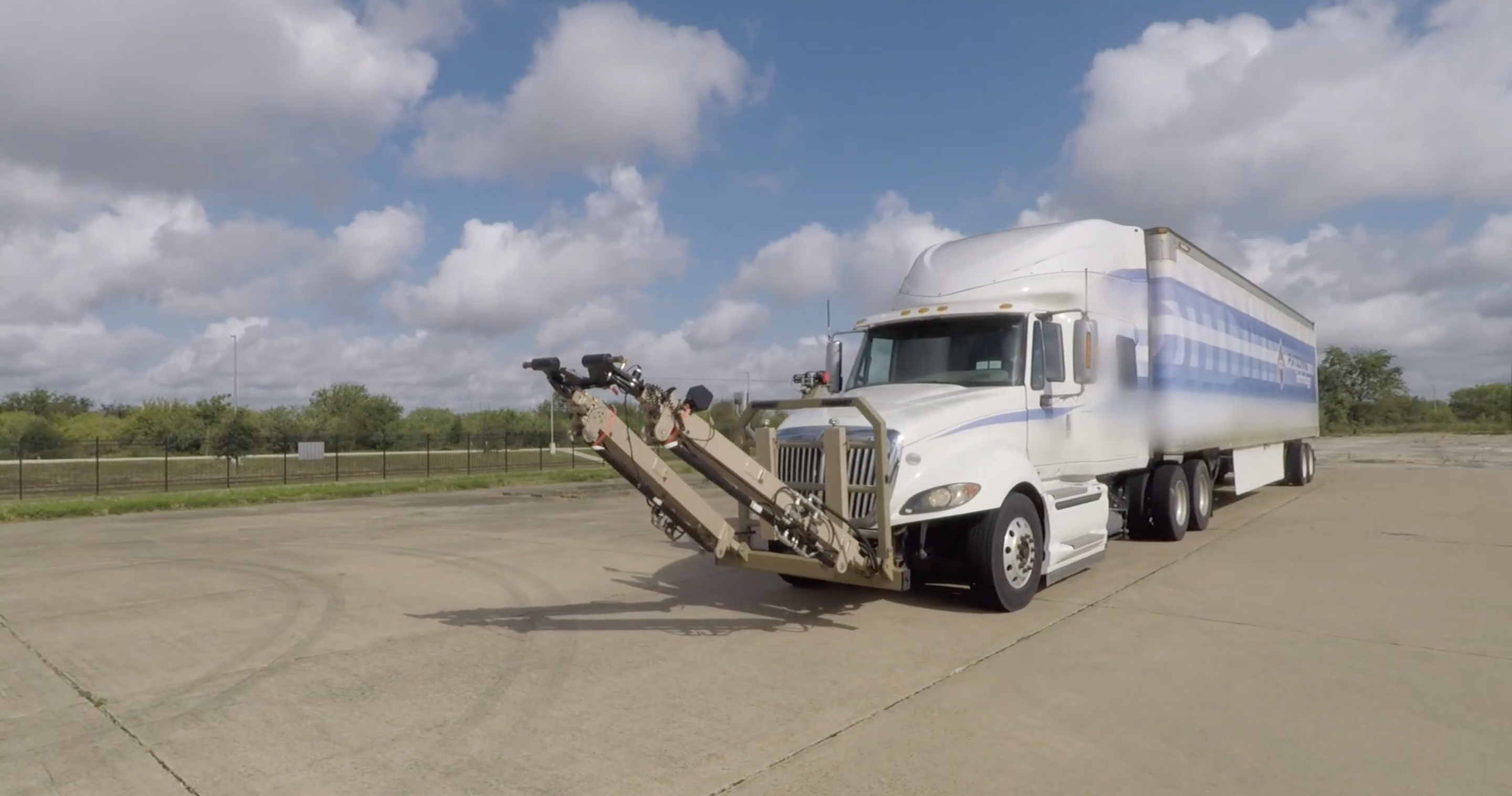
Hard Platooning
What is it?
Why is it needed?
Hard platooning provides benefits for the U.S. Military, transit systems, and the trucking industry by making transportation safer, more reliable, and more efficient. Transit agencies, which prioritize safety around pedestrians and cyclists, struggle to adopt fully autonomous vehicles due to safety concerns. This new system uses a human-driven lead vehicle with automated followers connected by a smart physical tether, solving these worries. This technology can solve labor shortages and boost productivity, without compromising safety for the trucking industry. For the military, this technology can enhance path tracking and expand ground vehicle capabilities. Unlike fully autonomous vehicles, this system uses the driver to bypass unpredictable obstacles, like bad weather and cybersecurity risks. The tether will transmit data between vehicles, ensuring they can follow the same path without needing changes to infrastructure.
What is CAST lab doing to improve it?
Current research focuses on accurate state estimation and control of each following vehicle to enable exact path following of the lead vehicle. Work involves analysis of system dynamics, development of nonlinear control strategies, and full-scale experimentation on both Class 8 trucks and transit buses. Successful implementation of this technology will support the movement of robotic assets in the defense sector and provide a scalable, reliable alternative for commercial and public transportation applications.
Select Publications & Links
- S. Gopalswamy, M. Ashley, and D. Franklin, "Automated vehicle platooning systems and associated methods," U.S. Patent 12 518 633, Jan. 6, 2026.
- M. Ashley, D. McMullan, and S. Gopalswamy, "Physically cooperating autonomous ground vehicles," SAE Technical Paper, presented at the 2023 NDIA Michigan Chapter Ground Vehicle Systems Engineering and Technology Symposium, Aug. 10, 2023.
- D. J. Franklin, M. Ashley, and S. Gopalswamy, "Application of Nonlinear Control for Hard Truck Platooning," in 2022 International Conference on Connected Vehicle and Expo (ICCVE), 2022, pp. 1-6.